Showing posts with label BE IT. Show all posts

Tuesday, July 15, 2014

SOFT COMPUTING (SC) [ELECTIVE], Semester 7, B.E. Computer Science (CS), December 2011.

SOFT COMPUTING (SC) [ELECTIVE], Semester 7,

B.E. Computer Science (CS), December 2011.
Con.6873-11
MP- 5602
(3 Hours)
[Total Mark: 100]

N.B. 1. Question No. 1 is compulsory

2. Attempt any Four out of remaining

3. Assume suitable data if necessary and justify the assumptions

4. Figures to the right indicate full marks

1. (a) Explain Mc cul loch Pitts Neuron Model with help of an example. --- (5 Marks)

(b) Define support, Core, Normality, Crossover point and α – cut for fuzzy set. --- (5 Marks)

(c) A neuron with 4 inputs has the weight vector w = [1 2 3 4]t. The activation function is linear, that is, the activation function is given by f (net) = 2* net. If the input vector is X == [5 6 7 8]t, then find the output of the neuron. ---- (5 Marks)

(d) Explain Fuzzy Extension principle with example. --- (5 Marks)

2. (a) High speed rail monitoring devices sometimes make use of sensitive sensors to measure the deflection of the earth when a rail car passes. These deflections are measured with respect to some distance from the rail car and, hence are actually very small angles measured in micro radians. Let a universe of deflection be A = [1, 2, 3, 4] where A is the angle in mieroradians, and let a universe of distances be D == [1, 2, 5, 7] where D is distance in feet, suppose a relation between these two parameters has been determined as follows: --- (10 Marks)

Now let a universe of rail car weights be W = [1, 2], where W is the weight in units of 100,000 pounds. Suppose the fuzzy relation of W to A is given by

Using these two relations, tind the relation R To S = T
  1. Using max-min composition
  2. Using max-product composition
(b) What is learning? Compare different learning rules. ---- (10 Marks)

3. (a) Explain Error back propagation training algorithm with the help of a flowchart. --- (10 Marks)

(b) Explain Genetic algorithm with the help of example. ---- (10 Marks)

4. (a) Explain Random Search method with example. ---- (10 Marks)

(b) A single neuron network using f(net) = sgn(net) has been trained using the pairs of (Xi, di) as given below : --- (10 Marks)

X1 = [1 -2 3 -1] t, d1 = -1
X2 = [0 -1 2 -1] t, d2 = 1
X3 = [-2 0 -3 -1] t, d3 = -1
The final weights obtained using the perception rule are
W4 = [3 2 6 1] t
Knowing that correction has been performed in each step for c=1, determine the following weights :

(a) W3,W2, W1 by backtracking the training.

(b) W5, W6, W7, obtained for steps 4,5,6 of training by reusing the sequence
(X1. d1), (X2, d2), (X3, d3)

5. (a) Explain with example perceptron learning rule. ---- (10 Marks)

(b) Explain with example gradient based optimization technique. ---- (10 Marks)

6. Design a fuzzy logic controller for a train approaching or leaving a station. The inputs are the distance from the station and speed of the train. The output is the amount of break power used. Use four descriptors for each variable use Mamdani Fuzzy model. ---- (20 Marks)

7. Write short notes on any two of the following: --- (20 Marks)

(a) TSP using simulated Annealing

(b) Kohonen's self organizing network

(c) Character Recognition using neural network

(d) RBF network

Thursday, June 26, 2014

Web Programming (WP) Semester 4 (3 Hours) May 2014

Web Programming

Web Programming (WP)
Semester 4
(3 Hours) May 2014


NP-19851
[Total Marks : 80]
 

N.B: (1) Question no 1 is compulsory.  
  (2) Write any three questions out of remaining.  
  (3) Assume suitable data if required.  
       
1. (a) Differentiate between GET and POST 05
  (b) Explain issues in web designing. 05
  (c) Explain PHP string functions. 05
  (d) Explain XMD DTD. 05
       
2. (a) Write Javascript program to change background colour continuously. 10
  (b) What is CSS? Explain the ways by which CSS is included in HTML. 10
       
3. (a) Explain page life cycle of JSP application. 10
  (b) Write an  ASP.NET program to insert a new record in database. 10
       
4. (a) What is XML and XSLT? Explain which an example. 05
  (b) Write a HTML code to illustrate use of table and lists 05
  (c) What is session tracking? What are the ways to do session tracking? how session tracking is done in PHP. 10
     
5. (a) Write a JSP program to display todays date. 05
  (b) Explain JavaScript objects Window and Document. 10
  (c) What is JQUERY ? Illustrate the use of JQUERY with a program. 05
       
6. (a) List various events on various HTML elements and explain Event handling in JavaScript with example. 10
  (b) Explain ADO.NET with example. 10

Thursday, June 19, 2014

Computer Graphic (CG) Semester 4 (Revised Course) (3 Hours) December 2013

Computer Graphic

Computer Graphic (CG)
Semester 4 (Revised Course)
(3 Hours) December 2013


LJ-10531
[Total Marks : 100]
 

N.B: (1) Questions no 1 is compulsory.  
  (2) Attempt any four questions out of the remaining six questions.  
  (3) Assume suitable data if necessary and justify the same.  
  (4) Figures to the right indicate full marks.  
       
1. (a) Explain character generation methods. 05
  (b) Explain inside outside test used in filling algorithm. 05
  (c) What is antialiasing, how can it be reduced. 05
  (d) Explain Z-buffer algorithm for removing hidden surfaces. 05
       
2. (a) Explain flood algorithm using 8-connected approach. Give its advantages and disadvantages. 10
  (b) Derive Bresenham's line drawing algorithm. Plot a line by using Bresenham's line generation algorithm from (1, 1) to (5, 3). 10
       
3. (a) Translate the square ABCD whose co-ordinate are A(0, 0), B(3, 0), C(3, 3) and D (0, 3) by 2  units in both direction and then scale it by 1.5 units in x-direction and 0.5 units in y-direction. 10
  (b) List and explain operations on segments. 10
       
4. (a) Find the clipping co-ordinate to clip the line segment AB against the window using cohen-sutherland line clipping algorithm.
Line - A (120, 60), B (160, 92)
Xwmin = 100     Ywmin = 80
Xwmax = 150    Ywmax = 100
10
  (b) Expalin Warnock's algorithm. 10
     
5. (a) State important properties of Bezier curve. Compare Bezier curves and B-spline curve. 10
  (b) Explain parallel and perspective projection? Derive the matrix for perspective projection. 10
       
6. (a) Explain 3D object representation methods. 10
  (b) Define the window, view port and derive window to viewport transformation. 10
       
7. Write short notes on :- 20
  (a) Colour Models  
  (b) Raster techniques  
  (c) Display file interpreter  
  (d) Fractals  
  (e) 3D clipping.  

Computer Graphic (CG) Semester 4 (Revised Course) (3 Hours) May 2013

Computer Graphic

Computer Graphic (CG)
Semester 4 (Revised Course)
(3 Hours) May 2013


GS-7110
[Total Marks : 100]
 

N.B: (1) Questions no 1 is compulsory.  
  (2) Attempt any four out of remaining questions.  
  (3) Assume suitable data if necessary and justify the same.  
       
1. (a) Explain the method to draw a thick line using Bresenham's algorithm. 05
  (b) Differentiate between Image space and Object space. 05
  (c) What is aliasing? Explain some antialiasing techniques. 05
  (d) Derive the transformation matrix to magnify the triangle A (0, 0), B(1, 2), C(3, 2) to twice its size so that the point C(3, 2) remain fixed. 05
       
2. (a) Explain Liang-Barsky line clipping algorithm. Apply the algorithm to the line with co-ordinates (30, 60) and (60, 25) against the window (xmin' ymin = (10, 10) and (xmax. ymax) = (50, 50). 10
  (b) Explain parallel and perspective projections. Perform a perspective projection of the unit cube when the center of projection is at xc = 10 yc = 10 on to z = 0 plane. 10
       
3. (a) Derive the composite transformation matrix for reflection of an object about a line
y=mx + c. Apply the derived matrix for the object A(4, 2) B(5, 3) C(6, 2) D(7, 1) on to the line y = 2x.
10
  (b) Derive the midpoint algorithm for ellipse generation. 10
       
4. (a) Explain weiber-Atherton algorithm for polygon clipping. What are its advantages over other polygon clipping algorithms? 10
  (b) Explain the different raster techniques and the transformation associated with it. 10
     
5. (a) Explain painter's algorithm. 10
  (b) Explain Gourand and Phong shading with their advantages and disadvantages. 10
       
6. (a) Explain computer assisted animation and frame- by- frame animation concepts. 10
  (b) Explain scan line fill algorithm with some suitable examples. 10
       
7. (a) Explain RGB and CMY colar models. 10
  (b) State the properties of Bezier curves. How can a Bezier surface be generated from a Bezier curve?  

Computer Graphic (CG) Semester 4 (Revised Course) (3 Hours) December 2012

Computer Graphic

Computer Graphic (CG)
Semester 4 (Revised Course)
(3 Hours) December 2012


KR-7253
[Total Marks : 100]
 

N.B: (1) Questions no 1 is compulsory.  
  (2) Attempt any four out of remaining questions.  
  (3) Assume suitable data if necessary and justify the same.  
       
1. (a) illustrate inside outside test. 05
  (b) Explain 3D display methods. 05
  (c) What is Z-buffer algorithm? 05
  (d) Write a note on Fractures. 05
       
2. (a) What is display file structure? Also explain the need for display file interpreter. 10
  (b) Write a pseudo-code to implement boundary fill and flood fill algorithm using 4 connected method. 10
       
3. (a)
Write an algorithm to fill polygon in fig (a) with pattern given in fig (b) of size m x n.
10
  (b) Derive Bresenham's line drawing algorithm for lines with slope <i. 05
  (c) Write different applications of computer Graphics. 05
       
4. (a) What do you mean by segment? What are the various attributes in segment table? State which operations can be done on segments and explain the same. 10
  (b) Derive the steps required to perform 3D rotations about arbitary axis. 10
     
5. (a) Find the clipping Co-ordinates to clip the line segment P1P2 against the window ABCD using cohen Sutherland line clipping algorithm.
     P1 (10, 30) P2 (80, 90)
     Window ABCD A (20, 20) B (90, 20)
                              C (90, 70) D (20, 70)
10
  (b) What do you understand by terms parallel and perspective projection? Also explain depth cueing. 10
       
6. (a) Explain Gouard and Phong shading. 10
  (b) Explain Bezier curves and Bezier surface with equations. Explain properties of Bezier curve. 10
       
7. Write short notes on :- 20
  (a) Animation  
  (b) Dithering techiniques  
  (c) Warnock's algorithm  
  (d) Half toning  
  (e) Raster techniques.  

Computer Graphic (CG) Semester 4 (Revised Course) (3 Hours) May 2012

Computer Graphic

Computer Graphic (CG)
Semester 4 (Revised Course)
(3 Hours) May 2012


GN-7937
[Total Marks : 100]
 

N.B: (1) Questions no 1 is compulsory.  
  (2) Attempt any four out of remaining questions.  
  (3) Assume suitable data if necessary.  
  (4) Figures to the right indicate full marks.  
  (5) illustrate answers with diagrams wherever required.  
       
1. (a) What are the applications of Computer Graphics. 05
  (b) Explain frame by frame Animation. 05
  (c) Explain Ray Tracing. 05
  (d) Explain Ant aliasing techniques. 05
       
2. (a) Write Bresenham's line drawing algorithm. Also write mathematical derivations for the same. 10
  (b) Explain 4-connected and 8-connected methods. Also explain flood fill and boundary fill algorithms. 10
       
3. (a) What is segment? Explain segment table and any four operations which can be performed on segments. 10
  (b)   10
       
4. (a) Explain Sutherland-Hodgeman polygon clipping algorithm. How Welier - Athorton algorithm solves the problem of concave polygon clipping? 12
  (b) Describe HSV and RGB color model. 08
     
5. (a) Explain the rotation of an object about an arbitrary point. Derive composite matrix for the same. 10
  (b) Describe 3D clipping of an object. 10
       
6. (a) explain painter's Algorithm. 10
  (b) Explain the bezier curve and write the properties of bezier curve. 10
       
7. (a) ExpSalain and compare Phong Shading and Gauard Shading. 10
  (b) Describe diffuse illumination and point-source illumination. 10

Wednesday, June 18, 2014

Computer Graphic (CG) Semester 4 (Revised Course) (3 Hours) May 2011

Computer Graphic

Computer Graphic (CG)
Semester 4 (Revised Course)
(3 Hours) May 2011


1. (a) What are different Application of Computer graphics? 05
  (b) Explain inside outside test used in filling algorithms. 05
  (c) Explain in brief Raster-scan display System 10
       
2. (a) Explain with example Scan fill algorithm 10
  (b) Derive matrix for 2-D Rotation about an arbitrary point. 10
       
3. (a) Derive the transformation matrix, when point P(x,y) is reflected about a line y=mx+c. 10
  (b) Give the steps along with the transformation matrix for the mapping of the 2-D object from window to viewport. 10
       
4. (a) Give the clipping algorithm which uses area codes for the end points of the line segment. Test it for a line P1P2 Where P1=(9. 9) and P2=(50, 20) against the window with (Xwmin, Ywmin)=(10, 10) and (Xwmax, Ywmax)=(20, 20). 15
  (b) Explain bit map method for character generation 05
     
5. (a) Develop an algorithm and give the steps for the moving car (side view). 10
  (b) Develop an algorithm and give the steps to continuously rotate a Triangle about a point. 10
       
6. (a) Give the properties of B-spline curve. 10
  (b) Explain Cyrus Beck line clipping algorithm 10
       
7. Write short notes on :- 20
  (a) Fractal  
  (b) Back face removal technique  
  (c) Perspective Projections  
  (d) Color models  
  (e) Half toning  
  (f) Octree.  

Computer Graphic (CG) Semester 4 (Revised Course) (3 Hours) December 2010

Computer Graphic

Computer Graphic (CG)
Semester 4 (Revised Course)
(3 Hours) December 2010


GT-6459
[Total Marks : 100]
 

N.B: (1) Questions no 1 is compulsory.  
  (2) Solve any four from remaining i.e. Q. 2 to Q. 7.  
  (3) Assume suitable data if necessary.  
       
1. (a) Explain characters Generation methods. 05
  (b) What is Phong's Shading Model? 05
  (c) List and explain operations on segments. 05
  (d) Draw Matrices for representing following operations :-
(i) Translation
(ii) Scaling
(iii) Rotation.
05
       
2. (a) Derive Bresenham\s line drawing algorithm. 10
  (b) Write pseudocoedes for boundary fill and flood fill procedure. 10
       
3. (a) Derive matrices for Rotation about an arbitary point. 10
  (b) Explain warnock's Algorithm. 10
       
4. (a) What do you understand by Diffuse illumination and point Source Illumination? 05
  (b) Write a short note on Bezier Curves?  
  (c) Write down all the matrices for Reflection for :-
(i) line y = 0
(ii) line x = 0
(iii) line y = x
(iv) line y =-x
(v) about origin.
05
     
5. (a) Derive Mid point circle algorithm. 10
  (b) Explain Text clipping with help of appropriate examples. 10
       
6. (a) What do you mean by specular Reflection? 05
  (b) Explain fractals in brief. 05
  (c) What is display file structure? Hence explain the need for display file interpreter 10
       
7. (a) illustrate inside-outside tests with examples. 10
  (b) Explain Midpoint Subdivision Algorithm.  

Tuesday, June 17, 2014

Computer Graphic (CG) Semester 4 (Revised Course) (3 Hours) May 2010

Computer Graphic

Computer Graphic (CG)
Semester 4 (Revised Course)
(3 Hours) May 2010


AN-3448
[Total Marks : 100]
 

N.B: (1) Questions no 1 is compulsory.  
  (2) Solve any four from remaining i.e. Q. 2 to Q. 7.  
  (3) Figures to the right indicate full marks.  
       
1. (a) Derive decision parameters for the midpoint ellipse algorithm (Region 1), assuming the starting position is (O, ry) and points are to be generated along the curve path in clockwise order and hence solve rx = 4, ry = 3. 10
  (b) Draw 3D transformation pipeline from modeling co-ordinates to final device co-ordinates of hence derive transformation from world co-ordinates to viewing co-ordinates. 10
       
2. (a) Write a boundary fill procedure to fill an 8-connected region. 05
  (b) Show transformation matrix for reflection about line y=-x is equivalent to reflection relative to y - axis followed by a counterclockwise pure rotation. 05
  (c) Write about the character generation methods. 05
  (d) Show that composition of two rotations is additive by concatenating matrix. 05
       
3. (a) Explain cohen-Sutherland line clipping algorithm. 10
  (b) Explain how Weiler-Atherton algorithm works for convex polygons? Clip the following polygon using the above
10
       
4. (a) Discuss the segment table along with operations on segments. What are the other display file structures used? 10
  (b) Solve using Liang barsky line clipping algorithm, where (xwmin' xwmax) = 1,9 and (ywmin' ywmax)= (2,8) for line
Segments      P1 (3,7) to P2 (3,10)
                    P3 (6,6) to P4 (8,9)
                    P5 (1,7) to P6 (11,1)
10
     
5. (a) Derive all the necessary matrices required to perform 3D Rotation about arbitary axis. 10
  (b) Write short notes on Text Clipping Methods. 05
  (c) Differentiate Parallel and perspective Projection. 05
       
6. (a) What is 3D clipping Derive equations for all the planes. (left, right, top, bottom, front, back). 10
  (b) Explain Sutherland Hodgeman polygon clipping algorithm. 10
       
7. Write short notes on :- 20
  (a) Warnock's algorithm  
  (b) Depth Buffer algorithm  
  (c) Shading algorithms  
  (d) B-Spline and Bezier Curves.  

Monday, June 16, 2014

Computer Graphic (CG) Semester 4 (3 Hours) December 2009

Computer Graphic

Computer Graphic (CG)
Semester 4
(3 Hours) December 2009


SP-8048
[Total Marks : 100]
 

N.B: (1) Questions no 1 is compulsory.  
  (2) Solve any four from remaining i.e. Q. 2 to Q. 7.  
  (3) Figures to the right indicate full marks.  
       
1. (a) Derive Mid Point Circle Algorithm; Hence state the algorithm. 10
  (b) Explain inside-outside Tests. 05
  (c) Explain Direct View Storage Tubes. 05
       
2. (a) Write a pseudo-code procedure to implement boundary-fill and flood-fill algorithm using the 4-connected definition for region pixels. 05
  (b) Express window to viewport mapping in the form of composite transformation matrix. Also find complete viewing transformation that maps a window in world
co-ordinates with x and y extent 1 to 10 onto a viewport with x extent 1/4 to 3/4

and y extent 0 to 1/2 in normalized device space, and then maps a workstation

window with x extent 1/4 to 1/2 and y extent 1/4 to 1/2 in the normalized device

space into a workstation viewport with x extent 1 to 10 and y extent 1 to 10 on the physical display device.
15
       
3. (a) Explain Cohen-Sutherland line clipping technique. 10
  (b) Explain Liang-Barsky line clipping technique. 10
       
4. (a) What do you understand by the terms parallel and perspective projection? Also explain depth cueing. 10
  (b) Explain all 3-D transformations along with matrix representations. 10
     
5. (a) Explain DDA algorithm. Solve (1, 1) to (5, 3) using DDA algorithm. 05
  (b) Solve using Bresenham's line drawing algorithm (20, 10) to (30, 18). 05
  (c) Explain the two techniques for producing color displays with CRT. 10
       
6. (a) Write Mid-Point Ellipse Algorithm Solve rx = 8 and ry = 6. 10
  (b) Explain Goroud Shading & Phong Shading. 10
       
7. Write short notes on the following any four :- 20
  (a) Z-Buffer Method  
  (b) Scanline Method  
  (c) Area Subdivision method  
  (d) Properties of B-spline Curves.  

Computer Graphic (CG) Semester 4 (Revised Course) (3 Hours) December 2009

Computer Graphic

Computer Graphic (CG)
Semester 4 (Revised Course)
(3 Hours) December 2009


SP-7812
[Total Marks : 100]
 

N.B: (1) Questions no 1 is compulsory.  
  (2) Attempt any four questions out of remaining six questions.  
  (3) Assume suitable data if necessary and justify the same  
       
1. (a) Explain Liang Barsky line Clipping algorithm and hence find the clipping candidates of line AB with end points (7, 5) and (9, 7), window boundaries given are (4, 4) and (10, 9). 10
  (b) Clearly differentiate between random scan and raster scan system. 05
  (c) Explain even-odd test to determine whether points is inside or outside of polygon. 05
       
2. (a) Explain midpoint ellipse algorithm with all required mathematical representation. 12
  (b) Explain scan line are conversion algorithm with suitable example. 08
       
3. (a) Prove that -
(i) 2D rotation and scaling commute if sx = sy or if Q n π  for integral n and that otherwise it do not.
(ii) Two successive rotations are additive i.e. R(Q1) R(Q2) = R (Q1 + Q2).
10
  (b) What is window and viewport. Assuming the window and viewport to be rectangular, derive the steps and the respective transformation matrix for transforming a point (Xw Yw) in a window to point  (Xv Yv) in viewport. 10
       
4. (a) Explain Sutherland Hodgmann polygon clipping algorithm with example. 10
  (b) Explain Warnock's algorithm used to remove hidden surfaces with example. 10
     
5. (a) Give properties and mathematical  equations for Bezier curve. Given the vertices of Bezier polygon as : Pο (1, 1), P1 (2, 3), P2< (4, 3) and P3 (3, 1), determine five points on Bezier curve. 12
  (b) Explain and compare boundary fill and flood fill algorithm. 08
       
6. (a) Explain Parallel and perspective projections. Derive the matrix for perspective projection. 10
  (b) What do you mean by segment? What are the various attributes in segment table? State which operations can be done on segments and explain the same. 10
       
7. Write short notes on the following any four :- 20
  (a) Fractals  
  (b) Specular Reflection  
  (c) Gouraud Shading  
  (d) Dithering techniques  
  (e) Half Toning  
  (f) Color Models.  

Computer Graphic (CG) Semester 4 (Revised Course) (3 Hours) May 2009

Computer Graphic

Computer Graphic (CG)
Semester 4 (Revised Course)
(3 Hours) May 2009


VR-3780
[Total Marks : 100]
 

N.B: (1) Questions no 1 is compulsory.  
  (2) Attempt any four questions out of remaining six questions.  
  (3) Assume suitable data if necessary and justify the same  
  (4) Figures to the right indicate full marks.  
  (5) Programming language can be C/C++/JAVA.  
       
1. (a) Explain Cyrus-Beck line clipping algorithm and solve the following example using it. Windows is specified by following polygon ABCDE and line to be clipped is P1 P2.

A(75, 100), B(150, 75), C(100,50), D(50, 50), E(25, 75), P1(25, 50), P2(150, 75). Calculate P1' and P2'. Note that figure is not to the scale.
08
  (b) Explain Display File Structure. How one can enter polygon into display file. 05
  (c) Explain even-odd test to determine whether the point is inside or outside of polygon. 05
       
2. (a) What is window? What is viewport? Assume window and viewport are rectangular. Derive the formulas required, for transforming a point (Xw', YW) in a window to point (Xv', Yv) in viewpoint. 08
  (b) Explain warnock's algorithm used to remove Hidden Surface with example. 12
       
3. (a) Derive 2D transformation matrix, for performing rotation of given point P(X,Y) by angle 0(theta) in anticlockwise direction about origin.
Also explain the steps required if rotation has to be carried out about Fixed Point (i.e. pivot point) (XF', YF).
10
  (b) Explain Bit-map character generation method. 05
  (c) What is computer Graphic? State various applications of it. (Specify only names). 05
       
4. (a) Explain sutherland-Hodgman Polygon cliping algorithm, with example. What modification is required on it so that it should also work on following figure.
(i.e. concave polygon)


12
  (b) Explain mid-point circle algorithm. In order to support your explanation, show mathematical derrivation. 08
     
5. (a) State mathematical equations for Bezier curves and Bezier Surface. Explain properties of Bezier Curve. 10
  (b) Compare Boundary fill and Flood fill algorithm. Illustrate one example with diagram where 4-connected approach fails, while 8 connected approach successes. 10
       
6. (a) Derive the transformations for producing perspective projection of an object, in xy plane. (viewing plane) and COP )Center of Projection) co-ordinates are (a, b, c). 12
  (b) What are fractals? Give classification of Fractals dimension? 08
       
7. (a) What do you mean by segment? What are the various attributes in segment table? State which operations can be done on segment and explain the same. 08
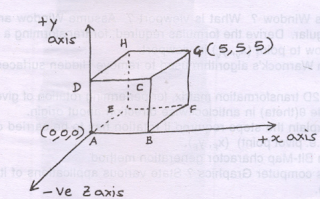
  (b) Consider the cube shown in the diagram.

Each side of the cube is 5 units. Co-ordinates of A are (0, 0, 0) co-ordinates of G are (5, 5, 5)
In order to perform rotation of cube about the axis joining vertices A and G by angle 45ο in anticlockwise direction, while looking from point G towards origin i.e. pt. A., which transformations are required and specify the matrices for the same.


Friday, June 13, 2014

Database Management Systems (DBMS) Semester 4 (Revised Course) (3 Hours) May 2013

Database Management Systems

Database Management Systems (DBMS)
Semester 4 (Revised Course)
(3 Hours) May 2013


GS-6996
[Total Marks : 100]
 

N.B: (1) Question no.1 is compulsory.  
  (2) Attempt any four questions out of ruminating six questions.  
  (3) Make suitable assumptions if needed.  
       
1. Galleries keep information about artists, their names (which are unique), birthplaces, age and style of art. For each piece of artwork the artist the year it was made, its unique title, its type of art (eg. painting, sculpture, photograph) and its price eg portraits still life work by Picasso or works of 19th Century; a given piece of work may belong to more than one group.
Each group is identified by a name (like those given) that describes the group Galleries keep into about customer's like persons (unique name, address, total amount spent and the artist and group of all the customers like.
 
  (a) Draw the ER diagram for the database. 08
  (b) Explain the rules to map ER to relations. 06
  (c) Explain Conflict serializibility. 06
       
2. (a) Company manufactures ranges of products which are purchased by customers.
The relational scheme for this operation is given as :
Company (company-code, cname, Director #.
Director-name, {product-name, cost {cost #,
Customer name, address} }) Where {...} represents the repeating groups.
 
(i) State the definitions of 1NF, 2NF, and # NF. 06
(ii) Normalize the above relational to 3NF. 06
06
  (b) Explain 2 PL protocol. 08
       
3. (a) What is recoverable schedule? Why recoverability of schedule is desirable?
Explain check point based recovery mechanism?
10
  (b) What is the condition for lossless de-composition of a relation? Give example. 05
  (c) Explain triggers with example. 05
       
4. (a) EMP (eid : inlegers, ename : string, age : integar, salary : real).
Works (eid : integer, did : integer, pctime : integer)
DEPT (did : integer, dname : string, budget : real, managerid : integer)
(i) Write SQL statement to create works relation. 02
(ii) Add Ram as an employee with id = 101, age = 32, salary =₹ 75000; 02
(iii) Give every employee 10% rise. 02
(iv) Find total no. of employees working in the department = 'Computer'. 02
(v) Arrange employees in descending order of their salary. 02
 
  (b) Explain organization of records in files, in the sequential file organization, why is an overflow block used even if there is at a given point only one overflow record? 10
     
5. (a) What is transaction? Discuss acid properties of a transaction. 10
  (b) Explain data dictionary storage. 10
  (c) Give the structure of B+ tree.
           OR
Explain static hashing.
05
       
6. (a) Explain UNDO and REDO operations for log based recovery. How are they used during recovery? 08
  (b) Give one protocol that prevents deadlock. 06
  (c) Describe different methods of deadlock recovery. 06
       
7. Write short notes on (any four) :- 20
  (a) Views in SQL  
  (b) keys and Referential integrity  
  (c) Data independence and its types  
  (d) Timestamp and ordering protocols  
  (e) Index definition in SQL.